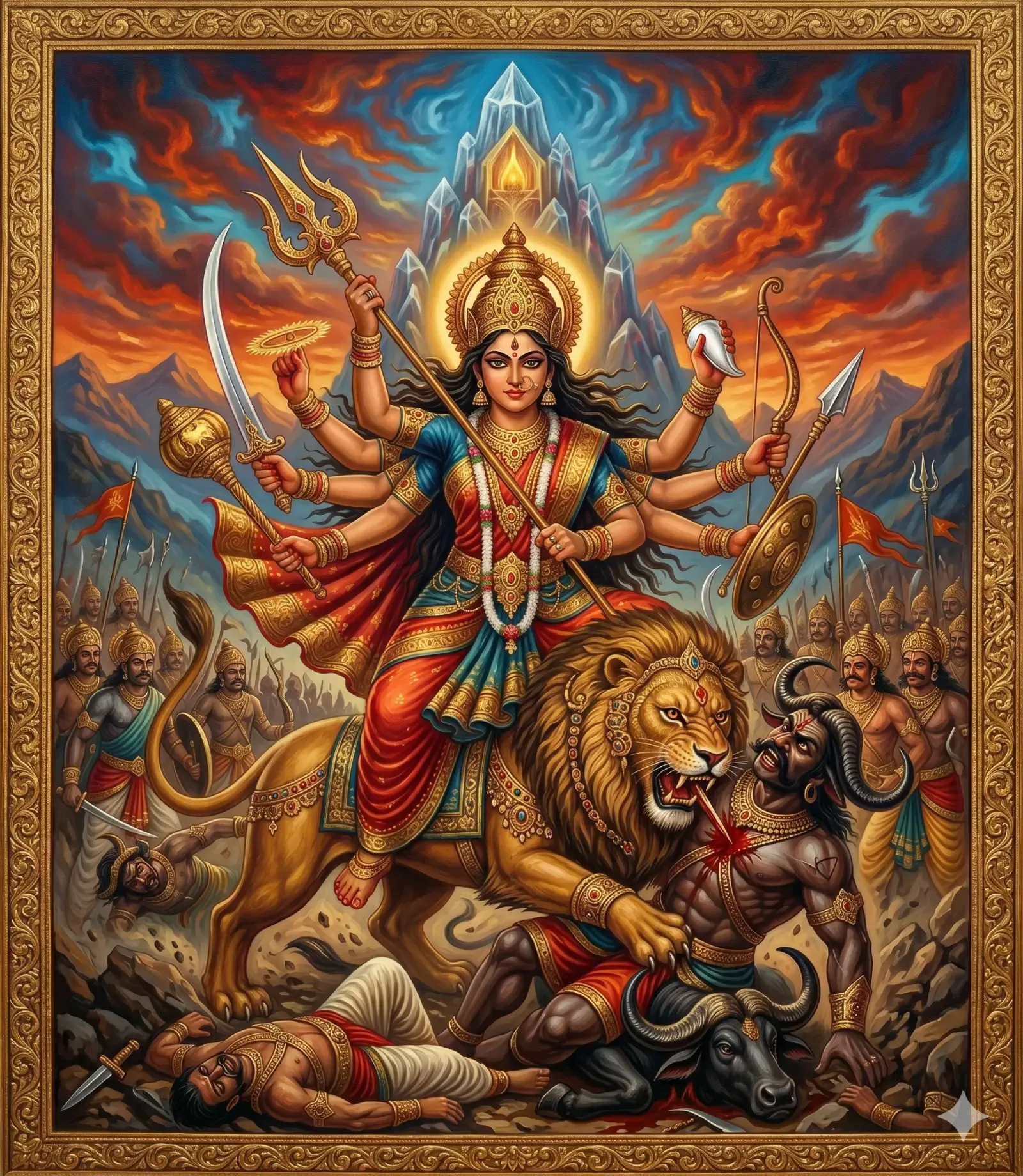
Shloka 1 अयि गिरिनन्दिनि नन्दितमेदिनि विश्वविनोदिनि नन्दनुते
गिरिवरविन्ध्यशिरोऽधिनिवासिनि विष्णुविलासिनि जिष्णुनुते।
भगवति हे शितिकण्ठकुटुम्बिनि भूरिकुटुम्बिनि भूरिकृते
जय जय हे महिषासुरमर्दिनि रम्यकपर्दिनि शैलसुते॥ १॥
Ayi Giri Nandini Nandita Medini Vishva Vinodini Nandanute
Giri Vara Vindhya Shiro Adhi Nivasini Vishnu Vilasini Jishnu Nute.
Bhagavati He Shiti Kantha Kutumbini Bhuri Kutumbini Bhuri Krite
Jaya Jaya He Mahishasura Mardini Ramya Kapardini Shaila Sute.
O daughter of the mountain (Himavan), you who fill the earth with joy and delight the entire universe, ever praised by the joyful gods! You who dwell upon the summit of the great Vindhya mountain, who are the playful beloved of Vishnu, praised by Indra (Jishnu)! O Goddess, intimate consort of the blue-throated Shiva, mother of a vast cosmic family, of countless auspicious deeds — Victory, Victory to you, O Mahishasura Mardini, slayer of the buffalo-demon, O beautiful one with braided locks, O daughter of the mountain!
Shloka 2 सुरवरवर्षिणि दुर्धरधर्षिणि दुर्मुखमर्षिणि हर्षरते
त्रिभुवनपोषिणि शङ्करतोषिणि किल्बिषमोषिणि घोषरते।
दनुजनिरोषिणि दितिसुतरोषिणि दुर्मदशोषिणि सिन्धुसुते
जय जय हे महिषासुरमर्दिनि रम्यकपर्दिनि शैलसुते॥ २॥
Suravara Varshini Durdhara Dharshini Durmukha Marshini Harsha Rate
Tribhuvana Poshini Shankara Toshini Kilbisha Moshini Ghosha Rate.
Danuja Niroshini Diti Suta Roshini Durmada Shoshini Sindhu Sute
Jaya Jaya He Mahishasura Mardini Ramya Kapardini Shaila Sute.
O bestower of boons upon the gods, crusher of the unconquerable, who patiently endures even the rage of ill-faced demons, ever delighting in joy! O nourisher of the three worlds, who gladdens Shankara (Shiva), remover of sins, who delights in the roaring war-cry of battle! O destroyer of the wrath of the Danavas, dissolver of the rage of Diti's sons (the demons), drainer of the pride of the arrogant, daughter of the cosmic ocean (Sindhu) — Victory to Mahishasura Mardini!
Shloka 3 अयि जगदम्ब मदम्ब कदम्बवनप्रियवासिनि हासरते
शिखरि शिरोमणि तुङ्गहिमालय शृङ्गनिजालय मध्यगते।
मधुमधुरे मधुकैटभगञ्जिनि कैटभभञ्जिनि रासरते
जय जय हे महिषासुरमर्दिनि रम्यकपर्दिनि शैलसुते॥ ३॥
Ayi Jagadamba Madamba Kadamba Vana Priya Vasini Hasa Rate
Shikhari Shiromani Tunga Himalaya Shringa Nijalaya Madhyagate.
Madhu Madhure Madhu Kaitabha Ganjini Kaitabha Bhanjini Rasa Rate
Jaya Jaya He Mahishasura Mardini Ramya Kapardini Shaila Sute.
O Mother of the universe, my own Mother! You who dwell joyfully in the beloved Kadamba forest, ever wearing a gentle smile of grace. You who reside in your own home at the highest peak of the great Himalaya, crown-jewel among mountains. O sweetness sweeter than honey (madhu), tormentor of the demons Madhu and Kaitabha, slayer of Kaitabha, ever delighting in the cosmic dance of rasa — Victory to Mahishasura Mardini!
Shloka 4 अयि शतखण्ड विखण्डितरुण्ड वितुण्डितशुण्ड गजाधिपते
रिपुगजगण्ड विदारणचण्ड पराक्रमशौण्ड मृगाधिपते।
निजभुजदण्ड निपातितखण्ड विपातितमुण्ड भटाधिपते
जय जय हे महिषासुरमर्दिनि रम्यकपर्दिनि शैलसुते॥ ४॥
Ayi Shata Khanda Vikhandita Runda Vitundita Shunda Gajadhipate
Ripu Gaja Ganda Vidarana Chanda Parakrama Shaunda Mrigadhipate.
Nija Bhuja Danda Nipatita Khanda Vipatita Munda Bhatadhipate
Jaya Jaya He Mahishasura Mardini Ramya Kapardini Shaila Sute.
O Goddess who scattered the headless trunks of enemies into a hundred fragments, who hewed off the proud trunks of the leaders of war-elephants! O fierce one, mighty in valour as the lion-king, whose ferocity tears asunder the temples of enemy elephants! O Goddess by whose mighty arm-rod the chiefs of the demon warriors are felled — limbs torn off, heads severed, hosts shattered — Victory to Mahishasura Mardini!
Shloka 5 अयि रणदुर्मद शत्रुवधोदित दुर्धरनिर्जर शक्तिभृते
चतुरविचार धुरीणमहाशिव दूतकृत प्रमथाधिपते।
दुरितदुरीह दुराशयदुर्मति दानवदूत कृतान्तमते
जय जय हे महिषासुरमर्दिनि रम्यकपर्दिनि शैलसुते॥ ५॥
Ayi Rana Durmada Shatru Vadhodita Durdhara Nirjara Shakti Bhrite
Chatura Vichara Dhureena Maha Shiva Duta Krita Pramathadhipate.
Durita Duriha Durashaya Durmati Danava Duta Kritanta Mate
Jaya Jaya He Mahishasura Mardini Ramya Kapardini Shaila Sute.
O wielder of the irresistible, unrelenting power of the gods (nirjara-shakti) — power that arose to slay the war-drunk, intoxicated enemies on the battlefield! O Goddess who, with subtle and strategic discernment, made the mighty Shiva himself a messenger and Pramatha (Shiva's ganas) your commander! O destroyer who became the cosmic end-bringer (Kritanta) for the messengers of the Danavas — those evil-acting, evil-intending, evil-minded demons — Victory to Mahishasura Mardini!
Shloka 6 अयि शरणागत वैरिवधूवर वीरवराभयदायकरे
त्रिभुवनमस्तक शूलविरोधिशिरोऽधिकृतामल शूलकरे।
दुमिदुमितामर दुन्दुभिनादमहो मुखरीकृत दिङ्निकरे
जय जय हे महिषासुरमर्दिनि रम्यकपर्दिनि शैलसुते॥ ६॥
Ayi Sharanagata Vairi Vadhuvara Vira Varabhaya Dayakare
Tribhuvana Mastaka Shula Virodhi Shiro Adhikrita Amala Shulakare.
Dumi Dumita Amara Dundubhi Nada Maho Mukharikrita Dingnikare
Jaya Jaya He Mahishasura Mardini Ramya Kapardini Shaila Sute.
O Goddess who grants fearlessness even to the wives and warriors of enemies who have surrendered to you! O bearer of the pure trident (amala-shula) that pierced the heads of those who threatened the three worlds, placing the trident upon the heads of the opposing demons! O Goddess whose praise made every direction resound with the great "dumi-dumi" beat of the divine drums (dundubhi) of the immortals — Victory to Mahishasura Mardini!
Shloka 7 अयि निजहुङ्कृति मात्रनिराकृत धूम्रविलोचन धूम्रशते
समरविशोषित शोणितबीज समुद्भवशोणित बीजलते।
शिवशिवशुम्भ निशुम्भमहाहव तर्पितभूत पिशाचरते
जय जय हे महिषासुरमर्दिनि रम्यकपर्दिनि शैलसुते॥ ७॥
Ayi Nija Hunkriti Matra Nirakrita Dhumra Vilochana Dhumra Shate
Samara Vishoshita Shonita Bija Samudbhava Shonita Bija Late.
Shiva Shiva Shumbha Nishumbha Maha Hava Tarpita Bhuta Pishacha Rate
Jaya Jaya He Mahishasura Mardini Ramya Kapardini Shaila Sute.
O Goddess who, with a single roar (hunkara) alone, annihilated the demon Dhumralochana ("smoky-eyed") and his hundreds of smoky-faced companions! O slayer who, like a creeper-vine of blood, withered Raktabija — the demon born again from every drop of his own blood — in the battlefield! O Goddess of the great Shaiva war against Shumbha and Nishumbha, in which the bhutas and pishachas (ghosts and goblins) were satisfied with offerings — Victory to Mahishasura Mardini!
Shloka 8 धनुरनुसङ्ग रणक्षणसङ्ग परिस्फुरदङ्ग नटत्कटके
कनकपिशङ्ग पृषत्कनिषङ्ग रसद्भटशृङ्ग हतावटुके।
कृतचतुरङ्ग बलक्षितिरङ्ग घटद्बहुरङ्ग रटद्बटुके
जय जय हे महिषासुरमर्दिनि रम्यकपर्दिनि शैलसुते॥ ८॥
Dhanur Anusanga Rana Kshana Sanga Pari Sphurad Anga Natat Katake
Kanaka Pishanga Prishat Kanishanga Rasad Bhata Shringa Hatavatuke.
Krita Chatur Anga Bala Kshiti Ranga Ghatad Bahu Ranga Ratad Vatuke
Jaya Jaya He Mahishasura Mardini Ramya Kapardini Shaila Sute.
O Goddess whose limbs glow with the bracelets that tremble and dance as you draw the bow at the decisive moment of battle! Your quiver overflows with golden arrows that strike down the proud horns and heads of the most formidable warriors. The entire field of the four-fold army (cavalry, chariots, elephants, infantry) becomes a many-coloured stage upon which young warriors cry out — Victory to Mahishasura Mardini!
Shloka 9 सुरललना ततथेयितथेयित थाभिनयोदर नृत्यरते
हासविलास हुलासमयिप्रणतार्तजने मितप्रेमभरे।
धिमिकिटधिक्कट धिक्कटधिमि ध्वनिघोरमृदङ्ग निनादरते
जय जय हे महिषासुरमर्दिनि रम्यकपर्दिनि शैलसुते॥ ९॥
Sura Lalana Tatatheyita Theyita Thabhinayodara Nritya Rate
Hasa Vilasa Hulasamayi Pranatarta Jane Mita Prema Bhare.
Dhimikita Dhikkata Dhikkata Dhimi Dhvani Ghora Mridanga Ninada Rate
Jaya Jaya He Mahishasura Mardini Ramya Kapardini Shaila Sute.
O Goddess in whose presence the celestial women dance in profound abhinaya, moving in the rhythmic syllables "tatha-theyita-theyita-tha"! You whose smiling, blissful play overflows in measured affection upon distressed devotees who have bowed at your feet! You who delight in the awesome beat of the great mridanga drum — "dhimikita-dhikkata-dhikkata-dhimi" — echoing through the battlefield — Victory to Mahishasura Mardini!
Shloka 10 जय जय जप्य जयेजय शब्दपरस्तुति तत्परविश्वनुते
झणझणझिञ्झिमि झिङ्कृतनूपुर सिञ्जितमोहित भूतपते।
नटित नटार्ध नटीनट नायक नाटितनाट्य सुगानरते
जय जय हे महिषासुरमर्दिनि रम्यकपर्दिनि शैलसुते॥ १०॥
Jaya Jaya Japya Jaye Jaya Shabda Parastuti Tatpara Vishva Nute
Jhana Jhana Jhinjhimi Jhinkrita Nupura Sinjita Mohita Bhuta Pate.
Natita Natardha Nati Nata Nayaka Natita Natya Sugana Rate
Jaya Jaya He Mahishasura Mardini Ramya Kapardini Shaila Sute.
O Goddess praised by the entire universe with the constant word of victory — "jaya, jaya, japya" — by those devoted to chanting your name! O enchantress of Shiva (Bhuta-pati), captivating him with the tinkling of your anklets ringing "jhana-jhana, jhinjhimi-jhinkrita"! O Goddess who delights in the divine play, where the Half-dancer (Ardhanarishvara — half-Shiva, half-Shakti) leads, dancers follow, and supreme song accompanies the cosmic Natya — Victory to Mahishasura Mardini!
Shloka 11 अयि सुमनः सुमनःसुमनः सुमनःसुमनो हरकान्तियुते
श्रितरजनी रजनीरजनी रजनीरजनी करवक्त्रवृते।
सुनयन विभ्रमर भ्रमरभ्रमर भ्रमरभ्रमर अधिपते
जय जय हे महिषासुरमर्दिनि रम्यकपर्दिनि शैलसुते॥ ११॥
Ayi Sumanah Sumanah Sumanah Sumanah Sumano Hara Kanti Yute
Shrita Rajani Rajani Rajani Rajani Rajani Kara Vaktra Vrite.
Sunayana Vibhramara Bhramara Bhramara Bhramara Bhramara Adhipate
Jaya Jaya He Mahishasura Mardini Ramya Kapardini Shaila Sute.
O Goddess endowed with the charming beauty of the noble-minded, the pure-hearted, the divine flowers, and the gods themselves — all simultaneously! O Goddess whose moon-bright face (rajani-kara = moon) surpasses the loveliness of night after night after night! O queen of charm whose beautiful eyes intoxicate, like the dance of a swarm of swarming bees (bhramara) gathering at the lotus — Victory to Mahishasura Mardini!
Shloka 12 सहितमहाहव मल्लमतल्लिक मल्लितरल्लक मल्लरते
विरचितवल्लिक पल्लिकमल्लिक झिल्लिकभिल्लिक वर्गवृते।
सितकृतफुल्ल समुल्लसितारुण तल्लजपल्लव सल्ललिते
जय जय हे महिषासुरमर्दिनि रम्यकपर्दिनि शैलसुते॥ १२॥
Sahita Maha Hava Malla Matallika Mallita Rallaka Malla Rate
Virachita Vallika Pallika Mallika Jhillika Bhillika Varga Vrite.
Sita Krita Phulla Samullasitaruna Tallaja Pallava Sallalite
Jaya Jaya He Mahishasura Mardini Ramya Kapardini Shaila Sute.
O Goddess who delights in fierce battle alongside the mightiest of wrestlers — even those who can subdue rallaka warriors! O Goddess surrounded by tribal women — the gentle creeper-women, village-women, jasmine-gatherers, cricket-keepers, and forest-dwelling Bhil women! O Goddess whose tender feet are graceful as freshly-bloomed crimson lotus-shoots, sweetly playful in their charm — Victory to Mahishasura Mardini!
Shloka 13 अविरलगण्ड गलन्मदमेदुर मत्तमतङ्ग जराजपते
त्रिभुवनभूषण भूतकलानिधि रूपपयोनिधि राजसुते।
अयि सुदतीजन लालसमानस मोहनमन्मथ राजसुते
जय जय हे महिषासुरमर्दिनि रम्यकपर्दिनि शैलसुते॥ १३॥
Aviralaganda Galanmada Medura Matta Matanga Jaraja Pate
Tribhuvana Bhushana Bhuta Kalanidhi Rupa Payonidhi Raja Sute.
Ayi Sudatijana Lalasa Manasa Mohana Manmatha Raja Sute
Jaya Jaya He Mahishasura Mardini Ramya Kapardini Shaila Sute.
O Goddess, mistress of the chief among war-elephants whose temples flow ceaselessly with intoxicating ichor (mada), the proud Matanga elephants in full rut! O ornament of the three worlds, daughter of the king of the ocean of beauty (payonidhi-raja-suta = like the daughter of the milk-ocean, Lakshmi), repository of all the arts! O daughter who excels Manmatha (Kamadeva) in enchanting the minds of those longing for grace — Victory to Mahishasura Mardini!
Shloka 14 कमलदलामल कोमलकान्ति कलाकलितामल भाललते
सकलविलास कलानिलयक्रम केलिचलत्कल हंसकुले।
अलिकुलसङ्कुल कुवलयमण्डल मौलिमिलद्बकु लालिकुले
जय जय हे महिषासुरमर्दिनि रम्यकपर्दिनि शैलसुते॥ १४॥
Kamala Dalamala Komala Kanti Kala Kalita Amala Bhala Late
Sakala Vilasa Kala Nilaya Krama Keli Chalat Kala Hamsa Kule.
Ali Kula Sankula Kuvalaya Mandala Mauli Milad Bakula Alikule
Jaya Jaya He Mahishasura Mardini Ramya Kapardini Shaila Sute.
O Goddess whose pure, creeper-like forehead bears all the digits of the moon, soft and lustrous as the petals of a pure lotus! O abode of all artistic graces, where royal swans (hamsa) move in playful, measured steps among your retinue! O Goddess on whose head the dark Bakula flowers and Kuvalaya lotuses meet — gathered round in clusters by swarms of buzzing bees — Victory to Mahishasura Mardini!
Shloka 15 करमुरलीरव वीजितकूजित लज्जितकोकिल मञ्जुमते
मिलितपुलिन्द मनोहरगुञ्जित रञ्जितशैल निकुञ्जगते।
निजगणभूत महाशबरीगण सद्गुणसम्भृत केलितले
जय जय हे महिषासुरमर्दिनि रम्यकपर्दिनि शैलसुते॥ १५॥
Kara Murali Rava Vijita Kujita Lajjita Kokila Manju Mate
Milita Pulinda Manohara Gunjita Ranjita Shaila Nikunja Gate.
Nija Gana Bhuta Maha Shabari Gana Sad Guna Sambhrita Kelitale
Jaya Jaya He Mahishasura Mardini Ramya Kapardini Shaila Sute.
O Goddess whose sweet flute-music from her own hand surpasses the cooing of the cuckoo — putting even that nightingale to shame with its enchanting beauty! O Goddess who dwells in the colourful mountain bowers, joined by the captivating tribal Pulinda people who hum with delight! O Goddess whose own retinue includes the great mountain-dwelling Shabari (Bhilla) women, full of true virtues, gathered together in your divine play — Victory to Mahishasura Mardini!
Shloka 16 कटितटपीत दुकूलविचित्र मयूखतिरस्कृत चन्द्ररुचे
प्रणतसुरासुर मौलिमणिस्फुर दंशुलसन्नख चन्द्ररुचे।
जितकनकाचल मौलिमदोर्जित निर्जरकुञ्जर कुम्भकुचे
जय जय हे महिषासुरमर्दिनि रम्यकपर्दिनि शैलसुते॥ १६॥
Kati Tata Pita Dukula Vichitra Mayukha Tiraskrita Chandra Ruche
Pranata Sura Asura Mauli Mani Sphurad Amshu Lasan Nakha Chandra Ruche.
Jita Kanakachala Mauli Madorjita Nirjara Kunjara Kumbha Kuche
Jaya Jaya He Mahishasura Mardini Ramya Kapardini Shaila Sute.
O Goddess whose yellow silk garment around your waist gleams with multicoloured rays that outshine the radiance of the moon! O Goddess whose toenails shine like moons, reflecting the brilliance of the jewels on the crowns of the gods and demons bowing at your feet! O Goddess whose bosom surpasses the proud, golden temples of the celestial elephants — even mightier than the golden Mount Meru itself — Victory to Mahishasura Mardini!
Shloka 17 विजितसहस्रकरैक सहस्रकरैक सहस्रकरैकनुते
कृतसुरतारकसङ्गर तारकसङ्गर तारकसूनुसुते।
सुरथसमाधि समानसमाधि समाधिसमाधि सुजातरते
जय जय हे महिषासुरमर्दिनि रम्यकपर्दिनि शैलसुते॥ १७॥
Vijita Sahasra Karaika Sahasra Karaika Sahasra Karaika Nute
Krita Surataraka Sangara Taraka Sangara Taraka Sunu Sute.
Suratha Samadhi Samana Samadhi Samadhi Samadhi Sujata Rate
Jaya Jaya He Mahishasura Mardini Ramya Kapardini Shaila Sute.
O Goddess praised by the thousand-rayed Sun, by the thousand-armed Sahasrarjuna, and by countless other thousand-fold ones who have been conquered by you! O Goddess who waged the great Taraka war, the war of the demon Taraka — and whose son Kartikeya slew the demon Taraka! O Goddess delighted by King Suratha and the merchant Samadhi (of the Devi Mahatmyam), who attained the supreme meditation by your grace — Victory to Mahishasura Mardini!
Shloka 18 पदकमलं करुणानिलये वरिवस्यति योऽनुदिनं स शिवे
अयि कमले कमलानिलये कमलानिलयः स कथं न भवेत्।
तव पदमेव परम्पदमित्यनुशीलयतो मम किं न शिवे
जय जय हे महिषासुरमर्दिनि रम्यकपर्दिनि शैलसुते॥ १८॥
Pada Kamalam Karunanilaye Varivasyati Yo Anudinam Sa Shive
Ayi Kamale Kamalanilaye Kamalanilayah Sa Katham Na Bhavet.
Tava Padam Eva Param Padam Ity Anu Shilayato Mama Kim Na Shive
Jaya Jaya He Mahishasura Mardini Ramya Kapardini Shaila Sute.
O auspicious one, abode of compassion! Whoever worships your lotus-feet day after day — how could he not become a dwelling-place of Lakshmi (Kamala), seated upon the lotus? O lotus-eyed Goddess! For me too, who constantly meditates that your feet alone are the supreme destination — surely, O auspicious one, what is unattainable? Victory to Mahishasura Mardini!
Shloka 19 कनकलसत्कल सिन्धुजलैरनुसिञ्चिनुते गुणरङ्गभुवं
भजति स किं न शचीकुचकुम्भतटी परिरम्भसुखानुभवम्।
तव चरणं शरणं करवाणि नतामरवाणि निवासि शिवं
जय जय हे महिषासुरमर्दिनि रम्यकपर्दिनि शैलसुते॥ १९॥
Kanaka Lasat Kala Sindhu Jalair Anu Sinchinute Guna Ranga Bhuvam
Bhajati Sa Kim Na Shachi Kucha Kumbha Tati Parirambha Sukhanubhavam.
Tava Charanam Sharanam Karavani Natamara Vani Nivasi Shivam
Jaya Jaya He Mahishasura Mardini Ramya Kapardini Shaila Sute.
Whoever sprinkles your stage of virtues (your puja place) with the radiant waters of the golden ocean (sacred consecration) — does he not surely attain the joy of embracing Shachi (Indra's queen) herself? O Goddess, abode of the speech of the bowing immortals, abode of all auspiciousness, I take refuge at your feet alone — Victory to Mahishasura Mardini!
Shloka 20 तव विमलेन्दुकुलं वदनेन्दुमलं सकलं ननु कूलयते
किमु पुरुहूतपुरीन्दुमुखी सुमुखीभिरसौ विमुखीक्रियते।
मम तु मतं शिवनामधने भवती कृपया किमुत क्रियते
जय जय हे महिषासुरमर्दिनि रम्यकपर्दिनि शैलसुते॥ २०॥
Tava Vimalendu Kulam Vadanendu Malam Sakalam Nanu Kulayate
Kimu Puruhuta Purindu Mukhi Sumukhibhir Asau Vimukhi Kriyate.
Mama Tu Matam Shiva Nama Dhane Bhavati Kripaya Kimuta Kriyate
Jaya Jaya He Mahishasura Mardini Ramya Kapardini Shaila Sute.
Your pure lunar lineage (Chandra-vamsha) and the radiance of your moon-like face illuminate and purify all things in the universe. Could even the lovely moon-faced damsels of Indra's celestial city (Puruhuta-puri = Amaravati) turn away in shame before your matchless beauty? My only thought, O Goddess whose wealth is the name of Shiva, is this: by your mere grace, what indeed cannot be accomplished for me? Victory to Mahishasura Mardini!
Shloka 21 अयि मयि दीनदयालुतया कृपयैव त्वया भवितव्यमुमे
अयि जगतो जननी कृपयासि यथासि तथानुमितासि रते।
यदुचितमत्र भवत्युररीकुरुतादुरुतापमपाकुरुते
जय जय हे महिषासुरमर्दिनि रम्यकपर्दिनि शैलसुते॥ २१॥
Ayi Mayi Dinadayalutaya Kripaya Eva Tvaya Bhavitavyam Ume
Ayi Jagato Janani Kripayasi Yathasi Tathanumitasi Rate.
Yad Uchitam Atra Bhavaty Urarikuruta Durutapam Apa Kurute
Jaya Jaya He Mahishasura Mardini Ramya Kapardini Shaila Sute.
O Uma! Please be compassionate to me in your tenderness toward the suffering and humble. O Mother of the universe, surely as you are — full of grace toward your devotees — so it is inferred and known of you. Whatever is fitting here, accept that; remove this great burning suffering of mine. This is my final prayer, O Goddess — Victory, Victory to Mahishasura Mardini, O beautiful one with braided locks, O daughter of the mountain!