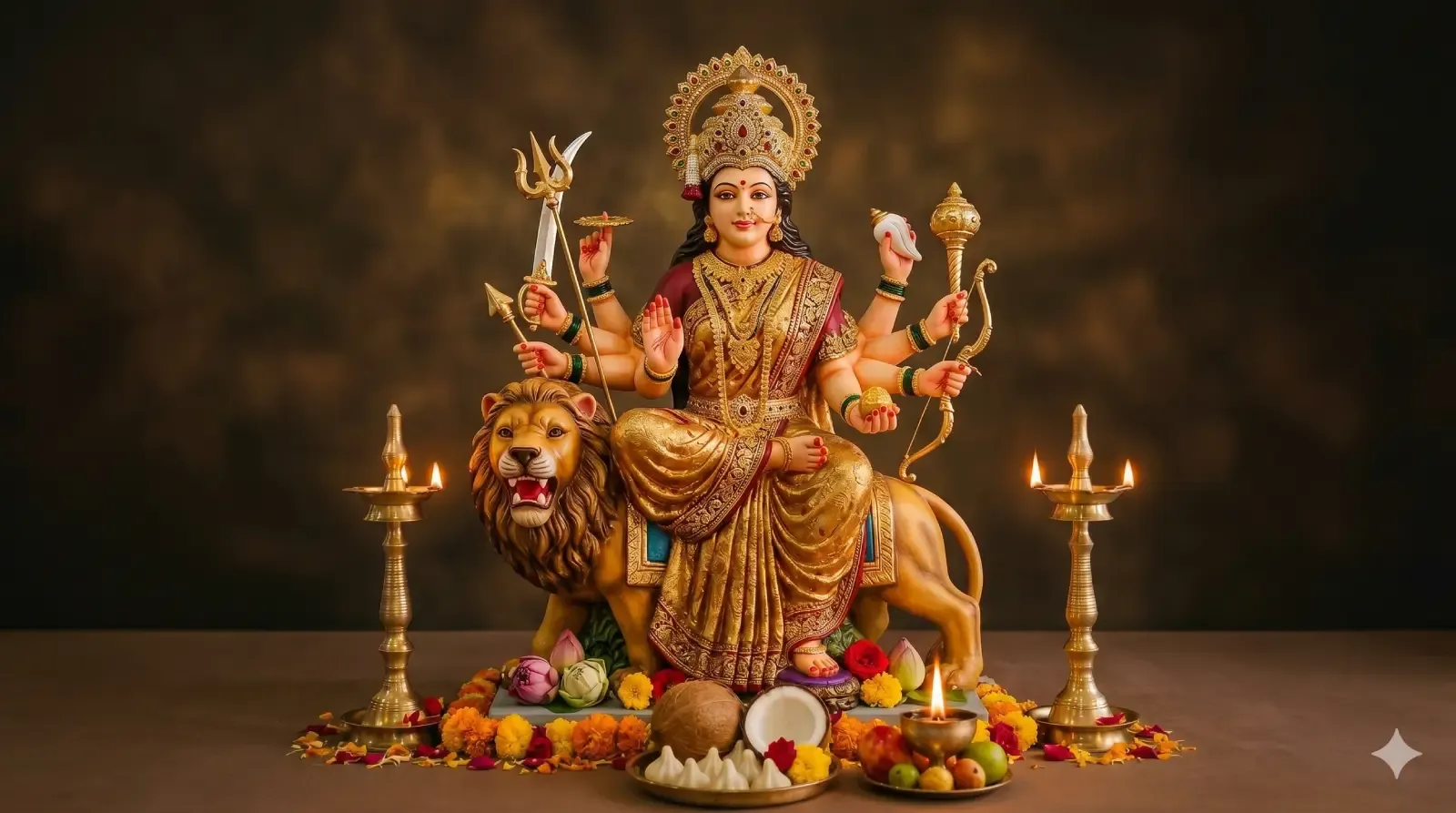
दुर्गा
Durga
Devotional Texts & Prayers
Durga (Durgā) — the invincible Goddess, the embodiment of Shakti (divine feminine energy) — is the supreme warrior deity who vanquished the demon Mahishasura after a nine-day cosmic battle. She is the unified form of all divine powers, wielding the weapons of all the gods. Worship of Durga during Navratri, the nine nights dedicated to the nine forms of the Goddess (Navadurga), is the most widely observed multi-day Hindu festival after Diwali.
Durga Devotional Texts
Stotra
दुर्गा स्तोत्र
Durga Stotra
Sanskrit
Durga Stotra — the "Ya Devi Sarva Bhuteshu" Devi Stuti from Durga Saptashati, invoking the goddess in nine divine manifestations, with the Sarva Mangala closing verse.
Read Stotra →महिषासुरमर्दिनी स्तोत्रम्
Mahishasura Mardini Stotram
Sanskrit · Adi Shankaracharya (traditional attribution)
Mahishasura Mardini Stotram — the celebrated 21-shloka Sanskrit hymn beginning "Aigiri Nandini," traditionally attributed to Adi Shankaracharya, praising Goddess Durga's victory over the buffalo-demon Mahishasura. Complete with verified Devanagari, IAST transliteration, and English meaning of every verse.
Read Stotra →About Durga
Durga is depicted riding a lion or tiger, with eight or ten arms each wielding a different divine weapon given by the gods — the trishula from Shiva, the chakra from Vishnu, the bow from Vayu, and so on. She is the collective power of all the gods manifested into one supreme feminine form specifically to defeat Mahishasura, the buffalo demon, when the gods themselves could not. The Devi Mahatmya (700 verses from the Markandeya Purana, also called Durga Saptashati or Chandi Path) is the most complete scripture on the Divine Mother and is recited in its entirety during Navratri.
In Vedic astrology, the Divine Mother — including Durga, Lakshmi, Saraswati, and Kali — is associated with the Moon (Chandra) and Venus (Shukra). Worship during the nine nights of Navratri (which occurs twice a year — in Chaitra/spring and Ashwin/autumn) is prescribed for all who seek protection, health, prosperity, and victory over enemies. The nine forms (Navadurga) worshipped across the nine nights are: Shailaputri, Brahmacharini, Chandraghanta, Kushmanda, Skandamata, Katyayani, Kalaratri, Mahagauri, and Siddhidatri.
Durga & Vedic Astrology
Associated Planet
Moon
Auspicious Day
Friday · शुक्रवार
Main Festival
Navratri
Rashifal for Moon-Influenced Signs
Frequently Asked Questions about Durga
What is Navratri and how many times does it occur each year?
Navratri ("nine nights") is the primary festival celebrating Goddess Durga and the nine forms of Shakti. It occurs four times a year in Vedic tradition: Chaitra Navratri (spring, March–April), Ashadha Navratri (monsoon, July — less widely observed), Ashwin Navratri (autumn, September–October — the most widely celebrated, also called Sharada Navratri or Maha Navratri), and Paush Navratri (winter, January — less widely observed). The Ashwin Navratri culminating in Vijayadashami (Dussehra) is the most universally observed, spanning nine nights of fasting, deity worship, and cultural performances.
What is the Mahishasura Mardini Stotra?
The Mahishasura Mardini Stotra is a Sanskrit hymn celebrating Durga's victory over the buffalo demon Mahishasura. It is set to a specific musical meter (Madhyama) that is meant to be chanted at a particular pace. The hymn begins with "Ayi Girinandini Nandita Medini" and contains 21 verses each describing a different aspect of the battle and the Goddess's divine form. It is traditionally recited at dawn during Navratri (Brahmamuhurta) and on Fridays. The All India Radio version, broadcast since 1936 every Mahalaya morning at 4 AM, is famous across Bengal as the start of the Durga Puja season.
What is the difference between Durga and Kali?
Durga and Kali are both manifestations of the supreme Goddess (Mahadevi/Adi Shakti) but represent different aspects. Durga is the warrior goddess in her controlled, protective form — beautiful, multi-armed, riding a lion, wielding divine weapons while maintaining composure. Kali is Durga's fierce, uncontrolled form — born from Durga's forehead during battle when her anger manifested as a distinct being. Kali is depicted as dark, wearing a garland of skulls, with her tongue out, representing the destruction of ego and time itself. Both are supreme manifestations of the Divine Mother.
Which Rashi natives benefit most from Durga worship?
The Divine Mother (Durga, Lakshmi, Saraswati) is associated with the Moon and Venus in Vedic astrology. Karka (Cancer — Moon-ruled) and Vrishabha (Taurus — Venus-ruled) Rashi natives benefit most from Goddess worship. Those with a weak or afflicted Moon, those facing health challenges, marital difficulties, or attacks from enemies, and women seeking protection and empowerment are advised to worship Durga during Navratri, on Fridays, and on the Ashtami (eighth lunar day) of each fortnight.
What is the Durga Saptashati (Chandi Path)?
The Durga Saptashati (700 verses of the Goddess) is a scripture from the Markandeya Purana containing 700 Sanskrit verses divided into 13 chapters, narrating three stories of the Goddess's battles against demonic forces. It is also called Devi Mahatmya ("Glorification of the Goddess") and Chandi Path in Bengal. The three stories represent the three qualities: Madhu-Kaitabha (Tamas), Mahishasura (Rajas), and Shumbha-Nishumbha (Sattva). Reciting the entire text in one sitting (which takes approximately 3 hours) is considered the most powerful spiritual practice during Navratri.