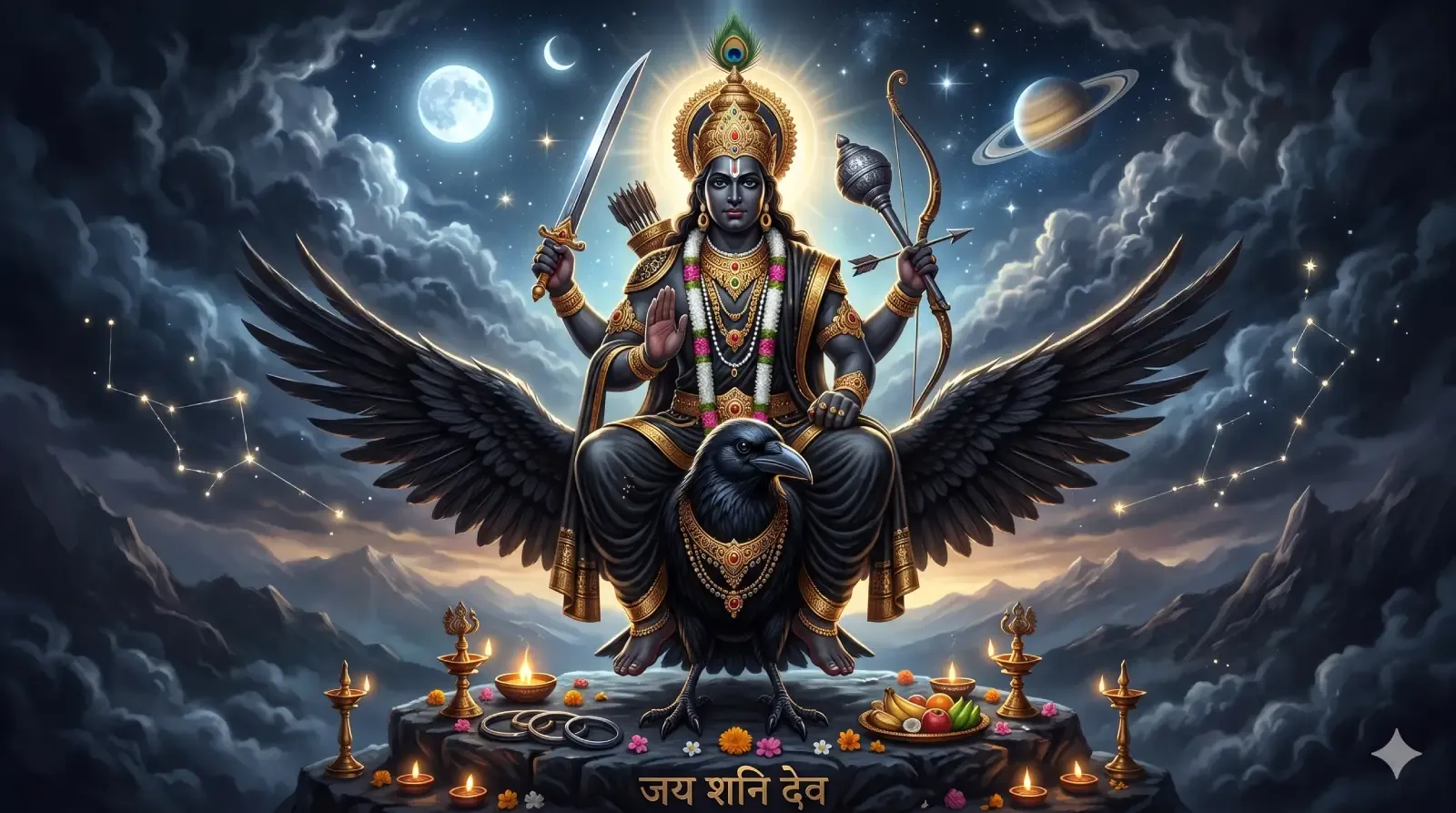
शनि
Shani
Devotional Texts & Remedies
Shani (Śani Dev) — the son of Surya and Chhaya, the cosmic enforcer of karma, and the slowest-moving of the nine planets (Navagraha) — is among the most feared yet most revered deities in Vedic tradition. His seven-and-a-half-year transit over the natal Moon (Sade Sati), his 19-year Mahadasha, and his transit across the 1st, 8th, and 12th houses are turning points that test, purify, and ultimately liberate the soul from the bondage of past karma. Worship of Shani on Saturdays (Shaniwar), recitation of the Dasharatha Krit Shani Stotram during Sade Sati, and offerings of black sesame, mustard oil, and iron are the classical remedies prescribed for those undergoing his testing periods.
Shani Devotional Texts
About Shani
Shani is depicted as dark-blue or black in colour, holding a trident, a bow, and a noose (pasha), seated on a vulture or a buffalo, with limping gait — said to come from a quarrel in childhood with his half-brother Yama. He is the son of Surya (the Sun) and Chhaya (the shadow). Despite his fearsome iconography, classical texts emphasise that Shani is supremely just — he gives only what one has earned. Suffering during Sade Sati is not punishment but the dissolution of accumulated karmic debt, after which the native enters a much purified and elevated phase of life.
In Vedic astrology, Shani rules Makara (Capricorn) and Kumbha (Aquarius) — both of which are stiff, disciplined, and karmic signs. His exaltation is in Tula (Libra) and his debilitation in Mesha (Aries). Natives undergoing Sade Sati, Shani Mahadasha or Antardasha, or any adverse Shani transit (especially over the 1st, 4th, 7th, 8th, or 12th houses from the natal Moon) are advised to recite the Dasharatha Krit Shani Stotram on Saturdays, observe a Saturday fast, donate black items (sesame seeds, urad dal, black cloth, iron, mustard oil) to those in need, and worship Hanuman — who is said to have freed Shani from Ravana's captivity and thereby earned Shani's lifelong protection of his devotees.
Shani & Vedic Astrology
Associated Planet
Saturn
Auspicious Day
Saturday · शनिवार
Main Festival
Shani Jayanti
Rashifal for Saturn-Influenced Signs
Frequently Asked Questions about Shani
Who is Shani Dev and why is he so feared?
Shani (Saturn) is the son of Surya (the Sun) and Chhaya (the shadow of Surya). He is the cosmic judge of karma — the planet that delivers the fruits, both bitter and sweet, of one's past actions across this and previous lifetimes. He is feared because his testing periods (Sade Sati, Shani Mahadasha, adverse transits) bring delays, obstacles, financial pressure, health concerns, and emotional weight. But classical Jyotish texts emphasise that Shani is the most just of all planets — he gives only what one has earned. His difficulties dissolve karma; those who endure his testing periods with patience, righteousness, and devotion emerge spiritually elevated and karmically lighter.
What is Sade Sati and how can the Dasharatha Krit Shani Stotram help?
Sade Sati is the seven-and-a-half year period during which Shani transits the natal Moon sign and the two signs adjacent to it (12th, 1st, and 2nd from the Moon). It is divided into three phases of roughly 2.5 years each — the rising phase (12th house transit), the peak phase (over the Moon itself), and the setting phase (2nd house transit). The Dasharatha Krit Shani Stotram, composed by King Dasharatha (father of Rama), carries Shani's own promise from the Padma Purana: anyone who recites it twice or thrice daily during Sade Sati, with purity and concentration, will be protected from all Saturn-caused afflictions.
Which Rashi natives benefit most from Shani worship?
Makara (Capricorn) and Kumbha (Aquarius) natives — both Saturn-ruled — should worship Shani regularly throughout life, since Shani is their Lagna or Rashi lord. Tula (Libra) natives benefit since Shani is exalted in Libra. Mesha (Aries) and Karka (Cancer) natives often face Shani as a malefic in dasha or transit and benefit greatly from remedies. Anyone undergoing Sade Sati (regardless of Moon sign), Shani Mahadasha (19 years) or Antardasha, or any adverse Shani transit over the 1st, 4th, 7th, 8th, or 12th houses from the natal Moon is advised to worship Shani on Saturdays.
Why is Saturday the day for Shani worship and what should be done?
Saturday (Shaniwar) is named for Shani himself. The traditional Saturday observances include: (1) bathing before sunrise and wearing dark blue, purple or black clothes; (2) lighting a mustard-oil lamp before a Shani idol or peepal tree; (3) reciting the Dasharatha Krit Shani Stotram and Shani Chalisa; (4) chanting the Shani Beej Mantra "Om praaṁ prīṁ prauṁ saḥ Śanaiścarāya namaḥ" 23 or 108 times; (5) donating black sesame seeds (til), urad dal, mustard oil, iron, or black cloth to the poor or to elderly labourers; (6) feeding crows, dogs, or buffaloes; and (7) visiting Hanuman temples — since Hanuman is the protector against Shani's adverse effects.
What is the connection between Hanuman and Shani?
According to Ramayana traditions, when Ravana imprisoned all the Navagraha (nine planets) in his palace to ensure auspicious horoscopes for his son Meghnad, Hanuman — during his search for Sita — discovered Shani among the captives. Hanuman freed Shani, and out of gratitude Shani promised that he would never trouble any devotee of Hanuman. This is why those undergoing Sade Sati, Shani Mahadasha, or adverse Saturn transits are advised to worship Hanuman alongside Shani — reciting the Hanuman Chalisa on Saturdays in addition to the Dasharatha Krit Shani Stotram. The combination is considered one of the most effective remedial practices in Vedic astrology.