शिव
Shiva
Devotional Texts & Prayers
Shiva (Śiva) — the Destroyer in the Hindu Trimurti, the Great Ascetic, the Lord of Kailash — is one of the most complex and beloved deities in all of Hinduism. He is simultaneously the destroyer and regenerator, the Mahayogi and the householder, the Tandava dancer and the still meditator. Worship of Shiva on Mondays, during Shravan month, and on Maha Shivaratri is among the most universally observed devotional practices across India and the Hindu diaspora worldwide.
Shiva Devotional Texts
Stotra
शिव पञ्चाक्षर स्तोत्र
Shiva Panchakshara Stotra
Sanskrit · Adi Shankaracharya
Shiva Panchakshara Stotra by Adi Shankaracharya — 5 Sanskrit verses meditating on the sacred five-syllable mantra Na-Ma-Shi-Va-Ya.
Read Stotra →शिव तांडव स्तोत्रम्
Shiva Tandava Stotram
Sanskrit · Ravana
Shiva Tandava Stotram — 15 Sanskrit shlokas composed by Ravana in praise of Lord Shiva's cosmic Tandava dance, in Druta Vilambita meter. Complete text with Devanagari, transliteration, and meaning.
Read Stotra →About Shiva
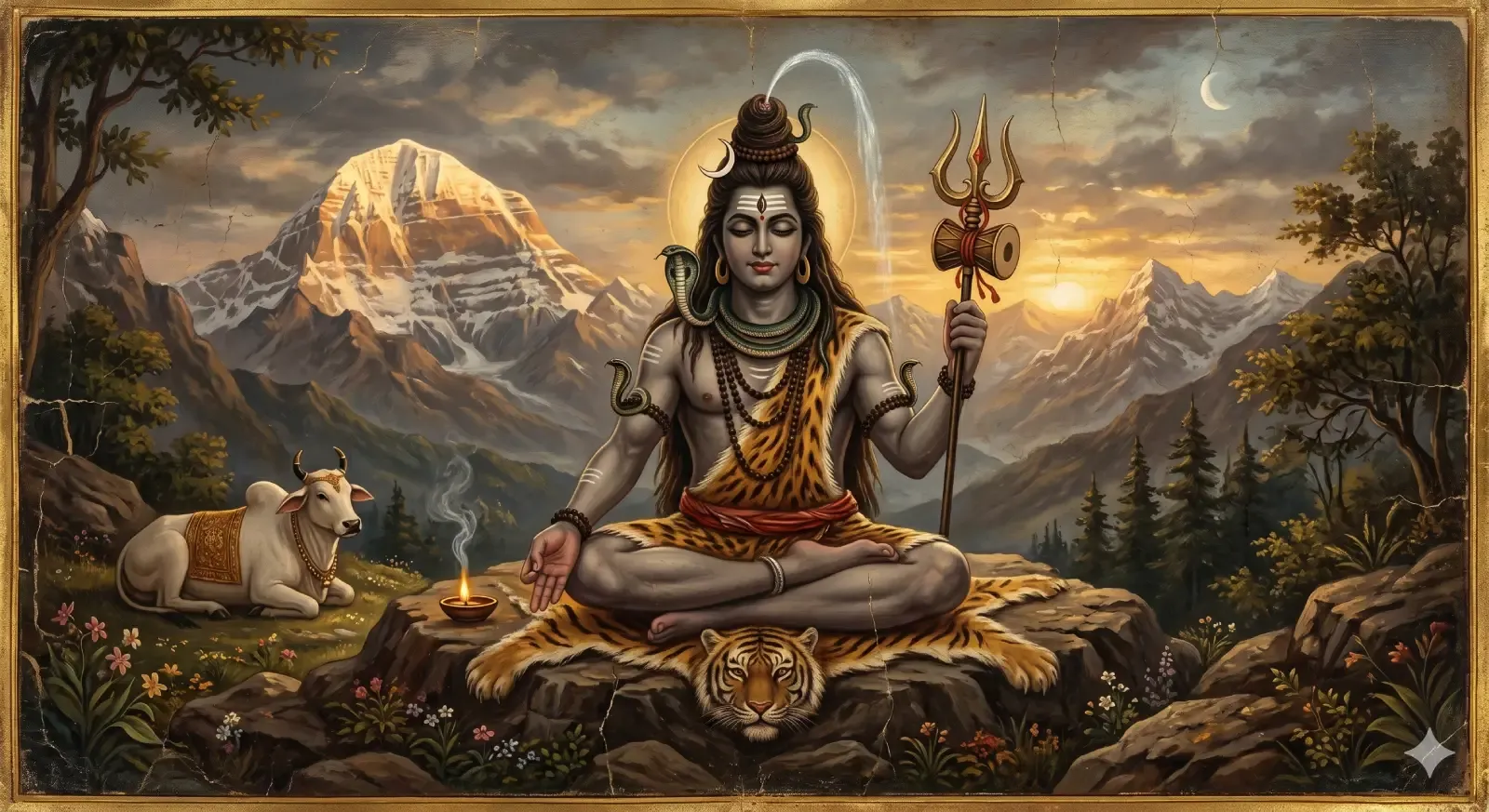
Shiva is depicted with a third eye (symbolising higher wisdom), the crescent moon in his matted hair, the sacred river Ganga flowing from his locks, a serpent around his neck, the Trishula (trident) in his hand, and smeared with ash (vibhuti) — representing transcendence over birth and death. The Shiva Panchakshara ("Om Namah Shivaya" — the five-syllable mantra) is considered the most potent of all Shaiva mantras, while the Maha Mrityunjaya Mantra from the Rigveda (7.59.12) is recited for healing, protection, and liberation.
In Vedic astrology, Saturn (Shani) — the planet of karma, discipline, and limitation — is considered a devotee of Shiva. Worship of Shiva is prescribed for those undergoing Sade Sati (Saturn 7.5-year cycle), Shani Mahadasha, or a malefic Saturn placement. Makara (Capricorn) and Kumbha (Aquarius) Rashi natives — both Saturn-ruled — benefit most from regular Shiva worship on Mondays. The Shravan month (July–August) is the most auspicious period for Shiva worship, when devotees carry Gangajal from Haridwar to anoint Shiva lingas.
Shiva & Vedic Astrology
Associated Planet
Saturn
Auspicious Day
Monday · सोमवार
Main Festival
Maha Shivaratri
Rashifal for Saturn-Influenced Signs
Frequently Asked Questions about Shiva
Why is Monday considered Shiva's day?
Monday (Somavar) is dedicated to Shiva because "Soma" is another name for the Moon (Chandra), and the Moon is depicted resting on Shiva's head. The crescent moon in Shiva's hair represents his mastery over time and cycles. Devotees fast on Mondays (Sawan Somavar especially), offer Gangajal, bilva (bel) leaves, and milk to the Shivalinga, and recite the Shiva Panchakshara or Maha Mrityunjaya Mantra. The first Monday of Shravan month is considered the most auspicious Monday of the year.
What is Maha Shivaratri and how is it observed?
Maha Shivaratri (The Great Night of Shiva) falls on the 14th lunar day (Chaturdashi) of the Krishna Paksha in the Phalguna month (February–March). It commemorates the night when Shiva performed the Tandava (cosmic dance) and when Shiva and Parvati were married according to some traditions. Devotees fast for the entire day and night, observe four prahar (3-hour) puja sessions, bathe the Shivalinga with Panchamrit (milk, curd, honey, ghee, and sugar), and chant Om Namah Shivaya through the night. Staying awake the entire night (jagran) is considered especially meritorious.
What is the Maha Mrityunjaya Mantra and its significance?
The Maha Mrityunjaya Mantra (Rigveda 7.59.12) is addressed to Tryambaka — the three-eyed Shiva. It reads: Om Tryambakam Yajamahe Sugandhim Pushtivardhanam / Urvarukamiva Bandhanan Mrityor Mukshiya Mamritat — "We worship the three-eyed Shiva who nourishes all beings; may he liberate us from death as a ripe cucumber is freed from its vine, granting us immortality." It is traditionally chanted 108 times daily for healing from illness, protection from untimely death, and liberation of the soul. It is the central mantra of the Rudrabhisheka ritual.
Which Rashi natives benefit most from Shiva worship?
Saturn (Shani) is considered a great devotee of Shiva. Makara (Capricorn) and Kumbha (Aquarius) Rashi natives — both Saturn-ruled — benefit most from Shiva worship. Those in Sade Sati (7.5-year Saturn transit over Moon sign and adjacent signs), Shani Mahadasha or Antardasha, or those with a malefic Saturn in their natal chart are advised to worship Shiva on Mondays and Saturdays and to observe Maha Shivaratri with a full fast. The Shiva Panchakshara and Maha Mrityunjaya Mantra are especially efficacious during these periods.
What is the significance of Bilva (Bel) leaves in Shiva worship?
Bilva (Aegle marmelos) leaves — offered in triads representing the three lobes of the leaf — are the most sacred offering to Shiva. The three lobes symbolise the Trinity (Brahma, Vishnu, Mahesh), the three eyes of Shiva, the three qualities (Sattva, Rajas, Tamas), and the three realms (Earth, Heaven, Netherworld). The Shiva Purana states that offering a single trifoliate bilva leaf to the Shivalinga is equivalent to offering thousands of flowers. Bilva leaves remain fresh and acceptable to Shiva even after they have fallen and dried, unlike other flowers.