विष्णु
Vishnu
Devotional Texts & Prayers
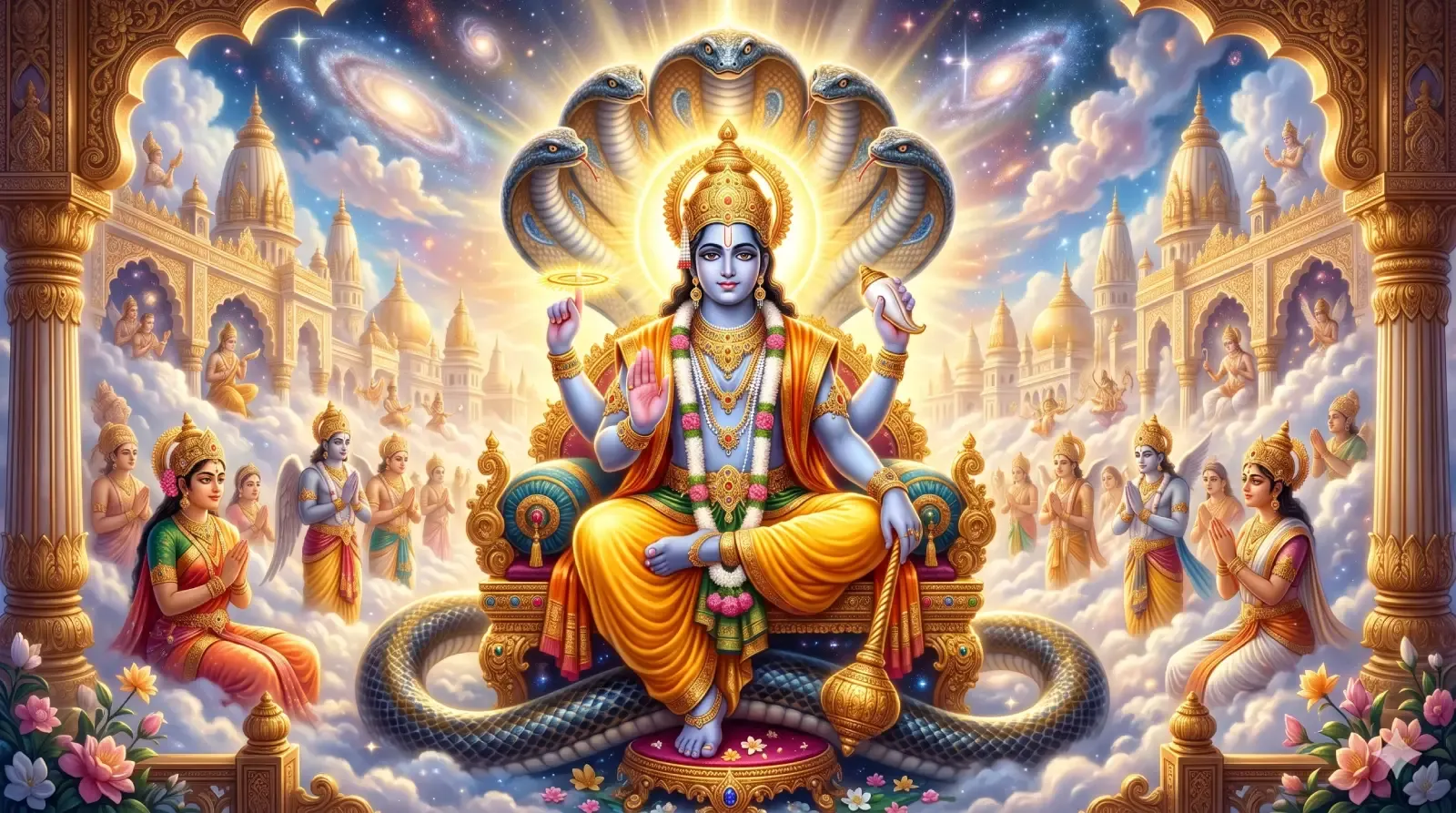
Vishnu (Viṣṇu) — the Preserver in the Hindu Trimurti, the supreme Lord of the Vaishnava tradition, who reclines on the cosmic serpent Adi Shesha in the Ocean of Milk while the universe is sustained from his very being — is the most widely worshipped form of the Supreme God across India and the Hindu diaspora. He descends in ten primary incarnations (Dasavatara) — Matsya, Kurma, Varaha, Narasimha, Vamana, Parashurama, Rama, Krishna, Balarama (or Buddha), and the future Kalki — to restore dharma whenever it declines. The Vishnu Sahasranama (1000 names of Vishnu) from the Mahabharata, the daily Aarti, and the Vedic Purusha Suktam form the core devotional practice for invoking his preserving grace.
Vishnu Devotional Texts
About Vishnu
Vishnu is depicted as a four-armed deity of dark-blue complexion (the colour of the infinite sky and ocean), holding the conch (Shankha — Panchajanya), the discus (Chakra — Sudarshana), the mace (Gada — Kaumodaki), and the lotus (Padma). He wears yellow silk (pitambara), the Shrivatsa mark on his chest, the Kaustubha gem around his neck, and is adorned with garlands of forest flowers (Vanamala). Goddess Lakshmi sits at his feet or beside him on the cosmic serpent Adi Shesha. From his navel sprouts the lotus on which Brahma sits creating the universe — making Vishnu the source of all creation, preservation, and the cosmic order.
In Vedic astrology, Vishnu is associated with Jupiter (Guru / Brihaspati) — the planet of wisdom, dharma, expansion, and divine grace. Dhanu (Sagittarius) and Meena (Pisces) Rashi natives — both Jupiter-ruled — benefit most from regular Vishnu worship. Those in Jupiter Mahadasha or Antardasha, students of dharma and philosophy, those seeking children (Vishnu is invoked specially during pregnancy), and those needing protection from any kind of negative force are advised to recite the Vishnu Sahasranama on Thursdays (Guruvar) and on Ekadashi (the 11th lunar day of each fortnight — sacred to Vishnu). Vaikuntha Ekadashi (Margashirsha Shukla Ekadashi in December–January) is held to be the supreme day of the year — the gates of Vaikuntha (Vishnu's abode) are said to open for the recitation of his thousand names.
Vishnu & Vedic Astrology
Associated Planet
Jupiter
Auspicious Day
Thursday · गुरुवार
Main Festival
Vaikuntha Ekadashi
Rashifal for Jupiter-Influenced Signs
Frequently Asked Questions about Vishnu
Why is Thursday considered Vishnu's day?
Thursday (Guruvar / Brihaspativar) is the day of Jupiter (Guru / Brihaspati) — the planet of wisdom, dharma, and divine grace. Vishnu is the presiding deity of Jupiter in Vedic astrology, so Thursday worship of Vishnu simultaneously pacifies Jupiter in the natal chart and invokes Vishnu's grace for spiritual and material wellbeing. The traditional observance includes bathing in the morning, wearing yellow clothes, lighting a ghee lamp before a Vishnu idol, offering yellow flowers, banana leaves, and a yellow dish (chana dal or kheer with turmeric), and reciting the Vishnu Sahasranama or Vishnu Chalisa.
What is the Vishnu Sahasranama and how should it be recited?
The Vishnu Sahasranama is the 1000 names of Vishnu — recorded in the Anushasana Parva (Chapter 149) of the Mahabharata, recited by Bhishma Pitamaha to Yudhishthira from his bed of arrows. Composed in 108 Anushtup-meter shlokas with Phalashruti and closing dialogues, it is considered the supreme devotional text in the Vaishnava tradition. Adi Shankaracharya wrote his most celebrated commentary on it. Best recited daily after a morning bath, on Saturdays (especially), on Ekadashi, on Vaikuntha Ekadashi, and during the Kartika and Margashirsha months. The recitation takes about 30 minutes and is said to grant protection from disease, fear, sin, untimely death, and to lead the devotee to Vaikuntha.
Who are the Dasavatara — the ten incarnations of Vishnu?
The Dasavatara are the ten primary descents of Vishnu to restore dharma: (1) Matsya (Fish) — saved the Vedas and Manu from the cosmic flood; (2) Kurma (Tortoise) — supported Mount Mandara during the churning of the ocean; (3) Varaha (Boar) — rescued the Earth from the demon Hiranyaksha; (4) Narasimha (Man-Lion) — slew the demon Hiranyakashipu to protect Prahlada; (5) Vamana (Dwarf) — subdued King Bali in three strides; (6) Parashurama — annihilated the corrupt warrior class; (7) Rama — defeated Ravana, restored dharma; (8) Krishna — guided the Pandavas, gave the Bhagavad Gita; (9) Balarama (or Buddha in some lists); (10) Kalki — the future avatar who will end the Kali Yuga. Each avatar has its own complete devotional tradition.
Which Rashi natives benefit most from Vishnu worship?
Dhanu (Sagittarius) and Meena (Pisces) natives — both ruled by Jupiter (Guru), Vishnu's planet — benefit most from regular Vishnu worship. Karka (Cancer) natives also benefit since Jupiter is exalted in Cancer. Those in Jupiter Mahadasha or Antardasha (a 16-year period), pregnant women (Vishnu is the protector of the unborn child), students of dharma and philosophy, those seeking spiritual liberation (moksha), and those born on Thursday are advised to recite the Vishnu Sahasranama on Thursdays and Ekadashis. The Sahasranama is also recited as the most powerful remedy for any kind of fear or chronic illness.
What is the significance of Ekadashi and Vaikuntha Ekadashi?
Ekadashi is the 11th lunar day of each fortnight — there are 24 Ekadashis in a year. Each is sacred to Vishnu and observed with a fast. The most powerful Ekadashi is Vaikuntha Ekadashi (also called Mukkoti Ekadashi), falling in the Margashirsha Shukla Paksha (December–January). According to the Padma Purana, on this day the gates of Vaikuntha — Vishnu's eternal abode — open to receive devotees. The recitation of the Vishnu Sahasranama on Vaikuntha Ekadashi is held to confer liberation in this very lifetime. Major temples like Tirumala, Srirangam, and the Vishnu temples of Kerala observe it as the supreme festival of the year.