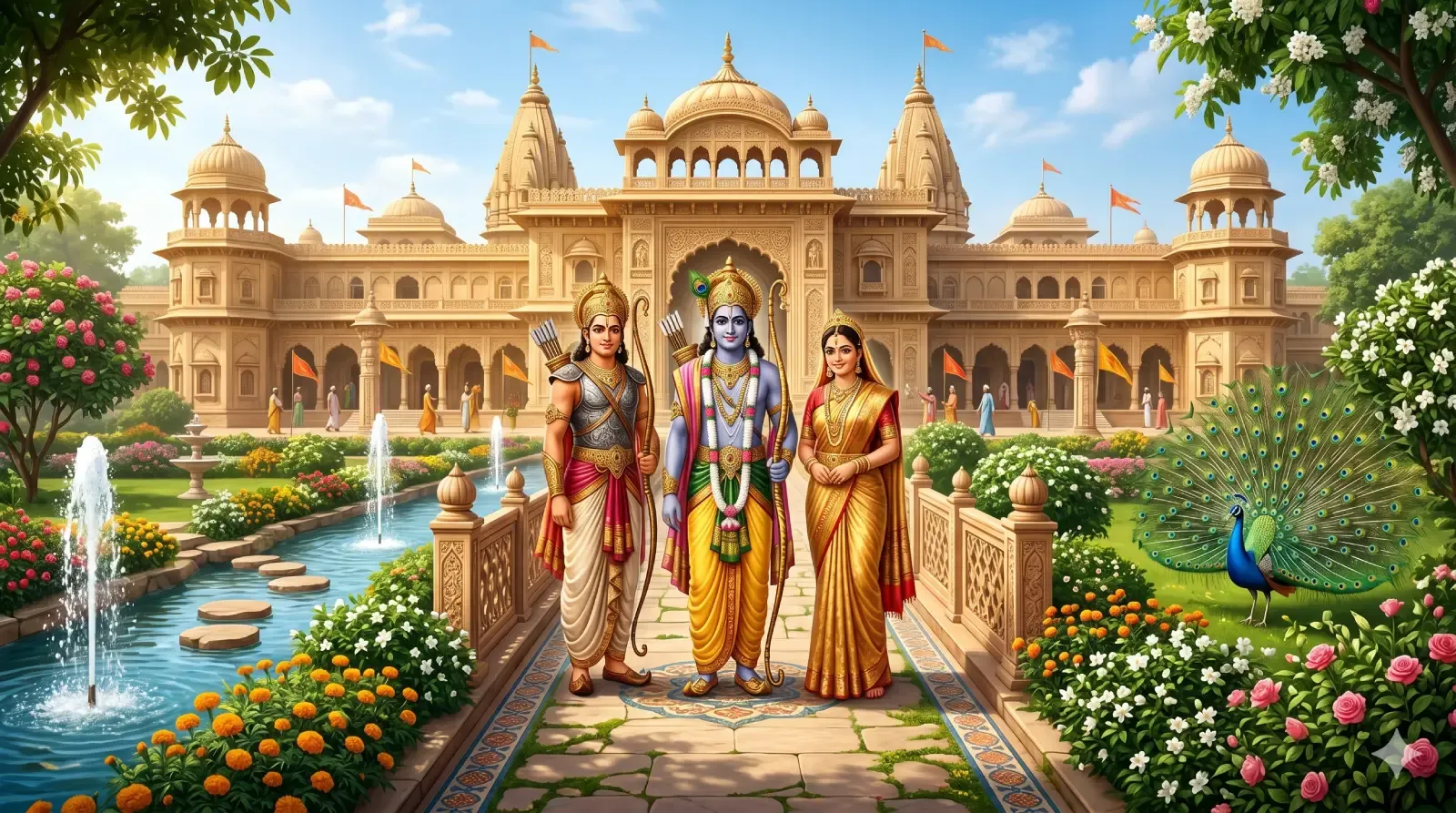
राम
Ram
Devotional Texts & Prayers
Ram (Rāma) — the seventh avatar of Vishnu, the ideal king (Maryada Purushottama), the hero of the Ramayana — is the most revered deity of the Vaishnava tradition and one of the most beloved figures across all of Hinduism. His story, told in Valmiki's Ramayana and Tulsidas's Ramcharitmanas, is the foundational narrative of dharma, devotion, and the victory of truth over falsehood. Ram Navami, celebrating his birth on the ninth lunar day of Chaitra, is one of the most widely observed Hindu festivals.
Ram Devotional Texts
About Ram
Ram is the son of King Dasharatha of Ayodhya, born on the ninth lunar day (Navami) of the Shukla Paksha of Chaitra month in the Treta Yuga. He is married to Sita, the daughter of King Janaka — herself a manifestation of Goddess Lakshmi. The Ramayana — composed by Valmiki in approximately 24,000 Sanskrit shlokas — narrates Ram's 14-year exile in the forest, the abduction of Sita by Ravana, and Ram's war against Lanka aided by Hanuman and the Vanara army, culminating in Ravana's defeat and the establishment of Ram Rajya (righteous governance) in Ayodhya.
In Vedic astrology, Ram is the divine avatar of the Sun's qualities: leadership, dharma, self-sacrifice, truth, and kingly virtue. Simha (Leo — Sun-ruled) and Mesha (Aries — ruled by Mars, a Sun-allied planet) Rashi natives find particular resonance with Ram's energy. The Ram Raksha Stotram, a Sanskrit prayer by Sage Budhakaushika, is one of the most powerful protective texts in Vaishnavism — traditionally recited 11 times on Ram Navami. The name "Ram" itself — a two-syllable Taraka Mantra — is considered so powerful that its repetition (Ram Naam Japa) is equated with chanting all 1000 names of Vishnu.
Ram & Vedic Astrology
Associated Planet
Sun
Auspicious Day
Sunday · रविवार
Main Festival
Ram Navami
Rashifal for Sun-Influenced Signs
Frequently Asked Questions about Ram
What is Ram Navami and how is it observed?
Ram Navami celebrates the birth of Lord Ram on the ninth lunar day (Navami) of the Shukla Paksha in the Chaitra month (March–April). It falls at the end of the nine-day Chaitra Navratri. Devotees fast on this day, read or listen to the Ramayana and Ramcharitmanas, perform special puja with Ram's idol, and observe community events including Ram Navami processions (Shobha Yatras). The most auspicious time is the Madhyahna (solar noon) period, traditionally said to be the birth time of Ram in Punarvasu Nakshatra with Cancer Lagna.
What is the Ram Raksha Stotram?
The Ram Raksha Stotram ("Protective Shield of Ram") is a Sanskrit hymn of 38 shlokas composed by Sage Budhakaushika, revealed to him in a dream by Lord Shiva himself. It describes Ram's divine form and invokes his protection over every part of the devotee's body — "Ram protect my head; Rama protect my forehead; Ramachandra protect my eyes..." It is considered one of the most powerful protective (kavach) texts in Vaishnavism and is traditionally recited 11 times on Ram Navami, and daily by devotees seeking physical and spiritual protection.
What is the significance of "Ram Naam" (chanting the name Ram)?
The name "Ram" (Rāma) is considered the Taraka Mantra — the mantra that enables the soul to cross the ocean of worldly existence. The Padma Purana states: "Vishnu-Sahasranama-stotra-punyam yat / Tat phalam labhate naro Ramanamaikatah smarat" — one who chants "Ram" once receives the merit of chanting all 1000 names of Vishnu. Adi Shankaracharya declared that "Ram Naam" is the essential essence of the Vishnu Sahasranama. Mahatma Gandhi's last words were "Hey Ram" — reflecting the centrality of Ram's name in Indian spiritual life across all traditions.
Which Rashi natives benefit most from Ram worship?
Ram is the avatar of the Sun's highest qualities — dharma, leadership, truth, and sacrifice. Simha (Leo — Sun-ruled) Rashi natives benefit most from Ram worship. Those in Sun Mahadasha or Antardasha, leaders, government officials, those seeking success in competitive examinations, those with Pitra Dosha (ancestral affliction) in their chart, and those born on Sunday are advised to worship Ram and chant the Ram Raksha Stotram regularly. Sundays and Ram Navami are the most auspicious times for Ram worship.
What is the Ramcharitmanas and how does it differ from the Valmiki Ramayana?
The Ramcharitmanas is a retelling of the Ramayana composed by saint-poet Tulsidas in the 16th century in Awadhi — the vernacular language of common people in North India. Unlike Valmiki's original Sanskrit Ramayana (24,000 shlokas, scholarly), the Ramcharitmanas (10,902 verses) was deliberately written in Awadhi so that all devotees — regardless of Sanskrit knowledge — could access Ram's story. It is structured in seven Kandas (books) set to musical meters. The Ramcharitmanas is the most widely recited Hindu scripture in North India and the basis for the Ram Navami, Dussehra, and Diwali celebrations.